
Technology · Sustainable Refrigerants & Solar-ready Systems
Cold storage that is ready for tomorrow's rules and today's power bill.
We choose low-impact refrigerants and design every system to take solar power, so you spend less on electricity and avoid costly changes later.
See how it works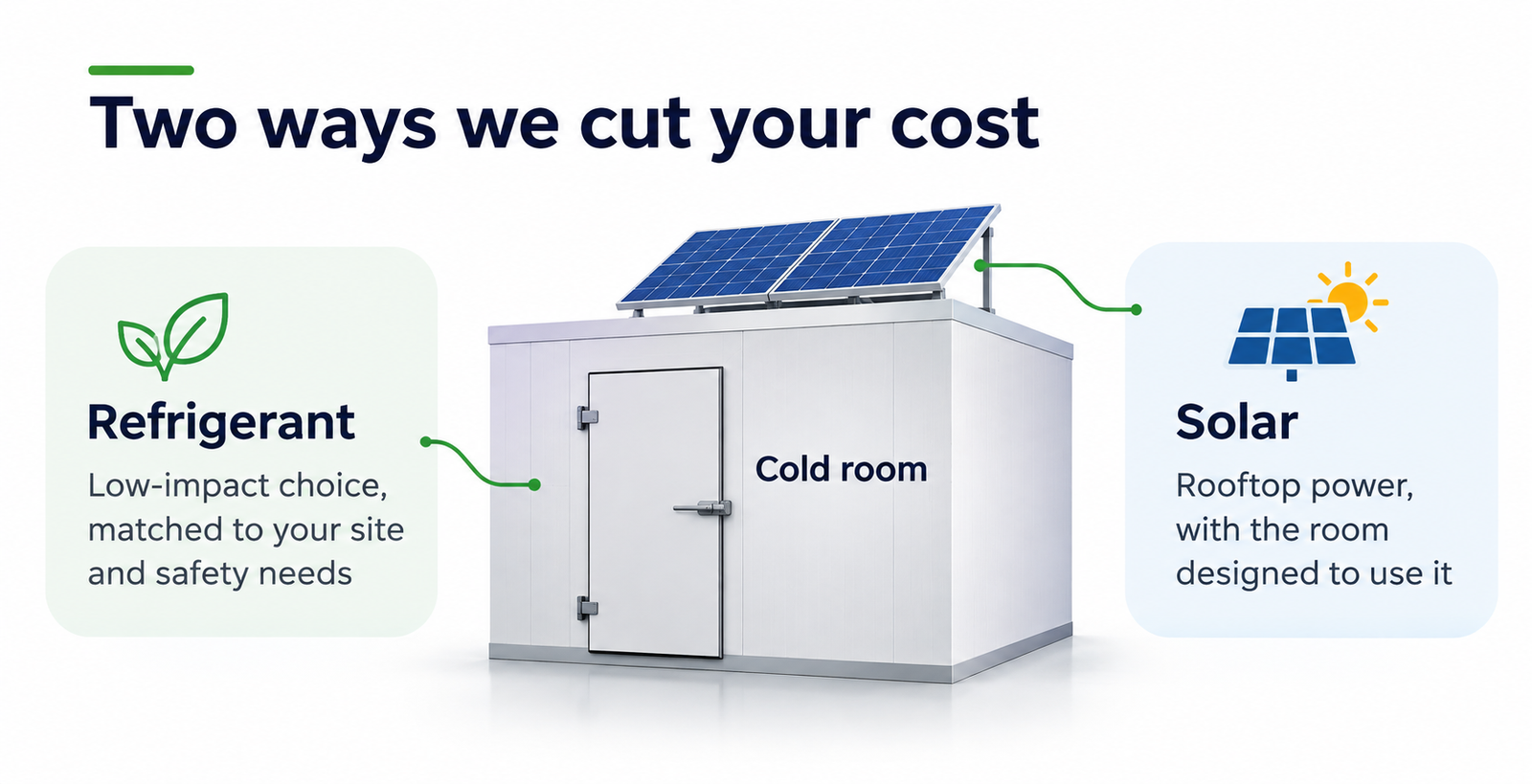
The problem
A cold room built for yesterday gets more expensive every year.
Many cold rooms still run on refrigerants that are being phased down worldwide, and ongrid power that keeps getting dearer. A plant built around the wrong refrigerant can face costly changes, higher service costs and tighter supply as rules tighten. A building with no provision for solar gives up one of the easiest savings available. [CONFIRM: regulatory wording]
We plan for both from the first drawing. Choosing the refrigerant and preparing for solar at design stage costs little. Adding them later costs a great deal.
How it works
From your site to a lower-impact, lower-cost system.
1
Understand your site
Climate, available roof or land, power tariff, safety requirements and local service support.
2
Choose the refrigerant
We compare options on efficiency, safety, running cost and future availability. [CONFIRM OPTIONS OFFERED]
3
Design for solar
Roof loading, electrical provisions and load timing planned so solar can be installed now or later.
4
Estimate the savings
Your estimate shows power drawn from the grid, the effect of solar and the expected payback.
What we plan for
Six choices that set your long-term cost.
Refrigerant selection
A low-impact option matched to your temperature, plant size and safety needs, rather than the default choice. [CONFIRM OPTIONS: for example, natural refrigerants or low-GWP blends]
System efficiency
Plant design that gets the most cooling from each unit of power,since efficiency is the first saving, before solar.
Leak prevention
Quality joints, sensible charge size and leak detection, because leaked refrigerant is lost money and lost performance.
Solar-ready structure
Roof strength, layout and mounting provisions planned in, so panels can be added without rework.
Electrical readiness
Panels, cabling and controls prepared to take solar power and to run the plant when the sun is strongest.
Load timing
Cooling schedules and, where it suits, thermal storage that use more solar power and less grid power. [CONFIRM: thermal storage offered]
The difference
Built for today vs built to last.
What you receive
A clear case for the greener option, in rupees.
Sustainability only helps your business if it pays. Every estimate shows the cost and the saving.