
Technology · AI & Design Intelligence
Designed from your data, not from habit.
We model your product, your load and your climate before we build, so every cold room is sized to the job and priced on what it costs to own.
See how it works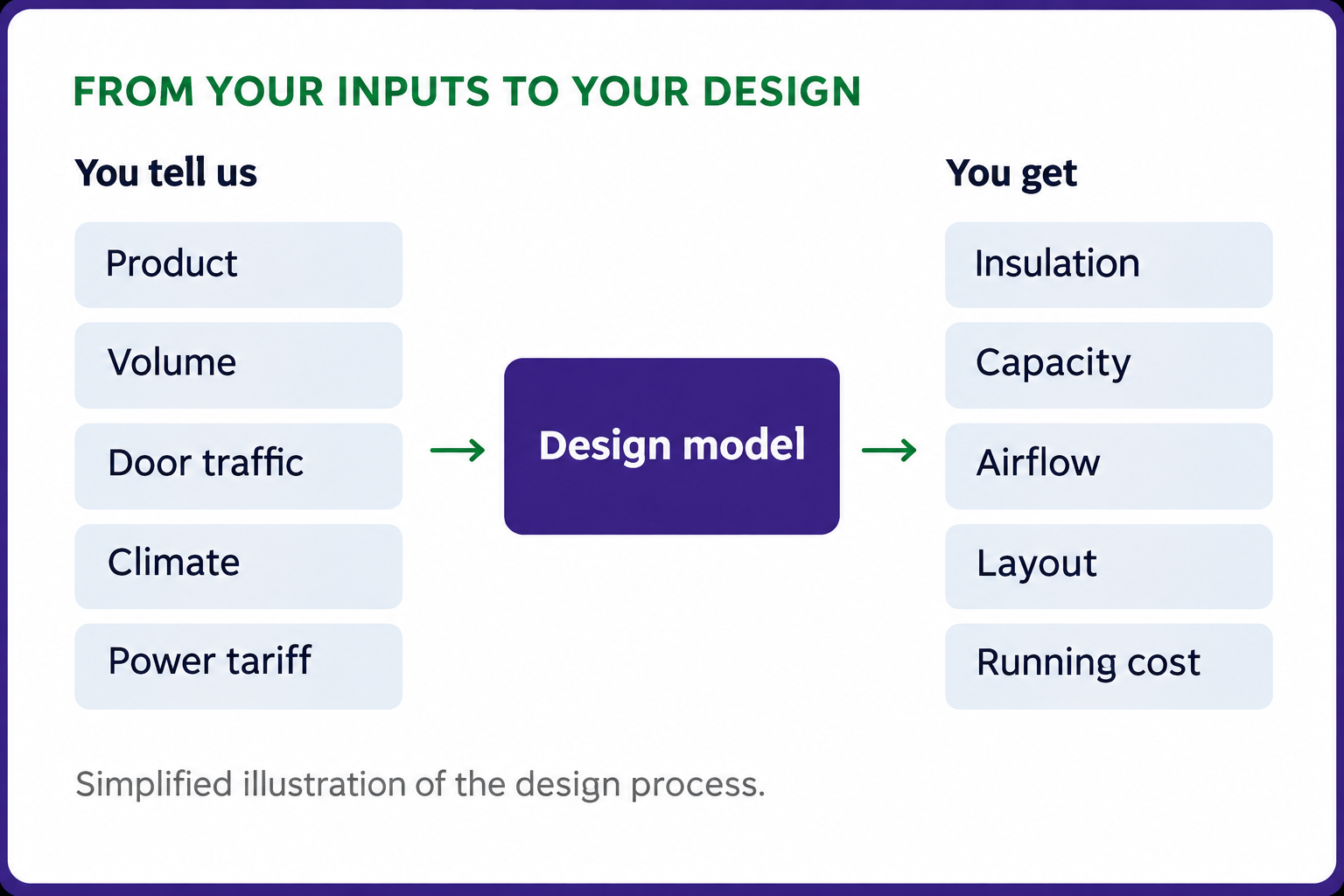
The problem
A standard size is a guess that you pay for every month.
Most cold rooms are sized by rule of thumb: a familiar panel thickness, a familiar compressor, a familiar layout. It is quick, and it often means extra capacity running all day, or too little capacity struggling on a hot afternoon.
We replace the guess with a model. We simulate your room, test the options and show you the cost of each before you decide. Better decisions made early are the cheapest savings there are.
How it works
From your inputs to a design you can trust.
1
Capture your inputs
Product, volume, daily movement, door traffic, site climate andyour power tariff.
2
Model the load
We simulate heat gain, product load and airflow to size each part ofthe room.
3
Compare options
Two or three designs are costed side by side, including runningcost over the years.
4
Check it after build
Monitoring data is compared with the model, so the design isproven, not assumed. [CONFIRM]
What the model decides
Six decisions that set your cost to own.
Insulation thickness
Enough to hold temperature at your climate and tariff, without paying for more than the savings justify.
Refrigeration capacity
Compressor and evaporator sized to the real load, including pull-down and peak days.
Airflow and layout
Fan placement and stacking plans that keep temperature even through the whole room.
Equipment selection
Components matched to your duty cycle and part-load behaviour, not just peak demand.
Control strategy
Setpoints, defrost and staging tuned to your operation, to avoid wasted cooling.
Running cost forecast
A monthly and yearly power estimate for each option, before you commit.Weather Makers – AI & Design Intelligence: Page Content Page.
The difference
Rule-of-thumb design vs Design Intelligence.
What you receive
Numbers you can take
to your finance team.
Every design comes with the figures behind it, in plain language.